
Market Entry Strategy Africa: How Global Brands Should Expand with Structure, Not Assumptions

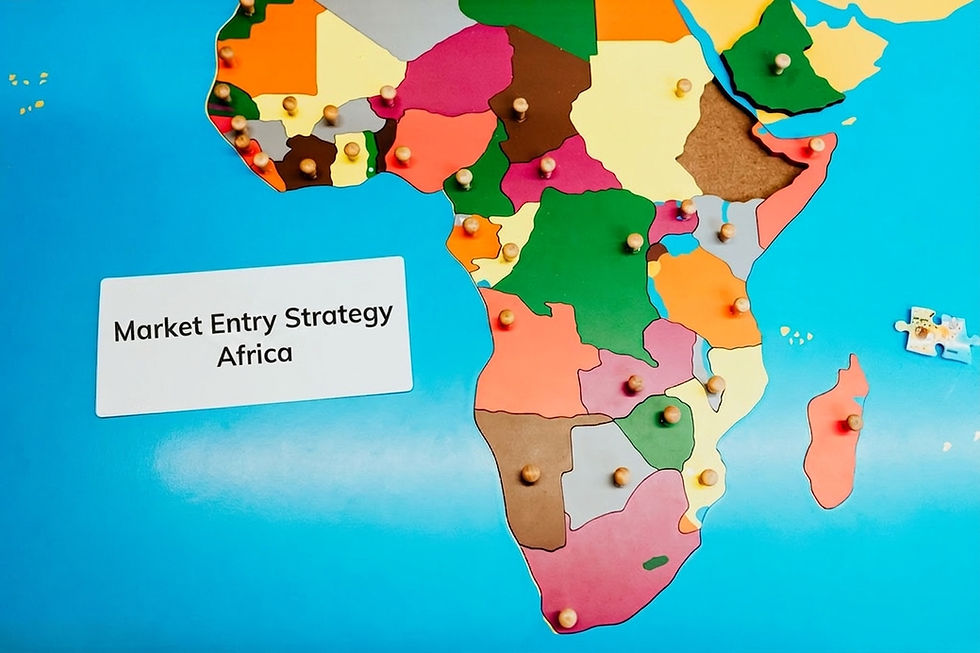
Africa is becoming one of the most important long-term growth frontiers for global brands. But serious expansion into Africa requires a disciplined market entry strategy built around sequencing, commercial fit, regulatory awareness, local execution, and long-term brand governance.
Too many companies still approach Africa with the wrong mental model. They either treat the continent as one market, or they underestimate it by assuming that demand alone is enough to make expansion work. Both positions are strategically weak.
Africa is not a single market. It is a multi-country, multi-speed, multi-regulatory growth environment with very different commercial realities across markets such as South Africa, Nigeria, Kenya, Egypt, and Morocco.
That is why a serious Africa market entry strategy must begin with structure.
Why Africa Requires a Structured Market Entry Strategy
Africa offers real commercial upside, but opportunity without architecture creates exposure.
Many brands enter African markets reactively. They receive inbound interest from one operator, one distributor, or one country and assume that is enough to begin. It usually is not.
A strong Africa market entry strategy should answer the following questions:
Which market comes first?
What is the right entry model?
What is the commercial objective?
Which categories are viable now?
What rights should be granted?
How will execution be governed?
Without this structure, expansion becomes fragmented, partners are misaligned, and execution weakens early.
The First Mistake: Treating Africa as One Market
Africa is often discussed as one opportunity. In reality, expansion happens country by country.
For instance, Nigeria is not Morocco. Kenya is not South Africa. Egypt operates differently from Ghana. North Africa and Sub-Saharan Africa have different dynamics.
This means prioritization is critical.
The right question is “Where do we start, and why?”
Choosing the Right Entry Model
Market entry success depends heavily on selecting the right structure.
Licensing: Scalable, but requires strong governance.
Distribution: Efficient for product flow, limited for brand building.
Franchising: Strong for consumer concepts and food businesses.
Joint Ventures: Deeper market integration.
Hybrid Models: Phased, evidence-based expansion.
The objective is strategic fit.
Partner Selection Is Critical
The wrong partner can delay growth, weaken execution, and block future opportunities.
The right partner should bring:
Financial strength.
Market access and network.
Operational capability.
Brand alignment.
Execution discipline.
Partner selection must be a structured evaluation, not a networking outcome.
Governance Drives Long-Term Success
Market entry does not end with signing a deal.
Without governance:
Brand positioning weakens.
Execution becomes inconsistent.
Retail performance declines.
Strong governance includes:
Approval controls.
Performance milestones.
Reporting requirements.
Audit rights.
Growth without governance is unmanaged exposure.
Cultural Intelligence Is a Competitive Advantage
Africa is culturally diverse and commercially nuanced.
Brands must balance:
Global consistency.
Local relevance.
Over-localization weakens identity. Under-localization limits adoption.The right approach preserves the brand while making it market-relevant.
Africa Should Be Part of a Broader Growth Strategy
Africa should not always be treated in isolation.
For many brands, it fits within a broader Middle East & Africa expansion roadmap, depending on:
Category strategy.
Partner ecosystems.
Long-term brand architecture.
The key is strategic alignment, not forced regional grouping.
What Global Brands Should Do
Prioritize markets strategically.
Select the right entry model.
Start focused, then scale.
Vet partners rigorously.
Build governance early.
Apply cultural intelligence.
Align with long-term growth strategy.
Key African Markets to Prioritize and Why
A disciplined African market entry strategy is built on prioritization. Not every market should be approached at the same time, and not every country plays the same role in a brand’s expansion roadmap.
The objective is to identify the right entry points based on what the brand is trying to achieve. Some markets offer scale. Others offer structure, regional connectivity, manufacturing relevance, or a more manageable first step into the continent.
South Africa
South Africa remains one of the most structured and commercially accessible markets on the continent. Its relatively advanced retail ecosystem, stronger distribution infrastructure, and more established consumer environment make it a practical starting point for many international brands.
For companies looking to test market positioning, execution capability, and partner performance in a more developed setting, South Africa often serves as a strong first move.
Nigeria
Nigeria offers one of the largest consumer opportunities in Africa. Its population scale, urban concentration, and category demand make it a strategically important market for brands seeking long-term volume and relevance.
At the same time, Nigeria is not a simple market. It requires strong local partners, operational discipline, and a realistic understanding of execution complexity. The upside is significant, but so is the need for structure.
Egypt
Egypt plays a unique role in many expansion strategies because it sits at the intersection of Africa and the Middle East. It offers scale, manufacturing capability, consumer depth, and broader regional relevance.
For brands thinking beyond a single-country entry, Egypt can function both as a standalone commercial market and as part of a wider MEA growth architecture.
Kenya
Kenya is one of the most important entry points into East Africa. It offers regional connectivity, a growing business environment, and increasing relevance for consumer brands seeking a foothold in that part of the continent. For many companies, Kenya is not only a market in itself. It is also a strategic platform from which broader East Africa expansion can be evaluated and sequenced.
Ethiopia
Ethiopia represents a major long-term opportunity due to its large population and future consumer potential. For brands with patience and a long investment horizon, it can become an important market over time. However, Ethiopia should be approached with realism. It is better suited for companies with a strategic long-term view than for those looking for immediate or low-friction market entry.
Tanzania
Tanzania adds important balance to an East Africa strategy. It offers growth potential, an expanding consumer base, and a useful position within regional trade dynamics. While it may not always be the first market to enter, it can play an important role as a second-stage expansion market once an initial East Africa platform is in place.
Morocco
Morocco is strategically relevant for brands looking at North Africa and parts of Francophone Africa. Its trade orientation, relative structure, and proximity to Europe make it an attractive market in the right category contexts. For some brands, Morocco is not just a destination market. It is a regional bridge.
Ghana
Ghana is increasingly seen as a stable and business-friendly market in West Africa. While smaller than Nigeria in scale, it can offer a more controlled and predictable entry environment for brands that want West Africa exposure without taking on the same level of complexity at the outset. In the right strategy, Ghana can serve as a measured first step before broader regional expansion.
Africa is not a short-term play, and it is not a market that rewards opportunistic entry. The brands that succeed will not be those that move first but those that move with clarity.
Clear on where to enter, how to structure their presence, who to partner with, and how to manage execution over time.
Expansion into Africa is about building growth, market by market, with intent and control.
The opportunity is real, but it is uneven. It requires prioritization, patience, and a willingness to invest in getting the fundamentals right from the beginning.
In that context, market entry becomes more than a commercial decision. It becomes a strategic commitment.
BBM Licensing supports global brands in structuring and executing market entry strategies across Africa and the Middle East, combining commercial strategy, licensing expertise, and culturally informed expansion models. Contact us to explore your Africa growth strategy.


Comments